A workplace safety meeting topic is a specific safety subject which a safety officer discusses during a brief team meeting. Such a meeting is often called a toolbox talk, safety briefing, or safety huddle. It typically runs 5–15 minutes.
The purpose of a workplace safety meeting is to help reinforce safe work practices, raise awareness of hazards, and prevent accidents.
Below are 18 of them, grouped by hazard type so you can pick one that fits today’s site conditions instead of scrolling a random list. Need copy-paste daily messages instead of full meeting topics? See our companion list of safety messages for work.

Any industry can hold safety meetings. The following, however, may require frequent meetings due to their greater emphasis on worker safety:
- Landscaping
- Material Handling
- Public Utilities
- Industry and manufacturing
- Construction
- Security and policing
- Firefighting
- Trades
- Healthcare Facilities
- Oil and Gas Industry
- Waste Management
- Forestry and logging
Key Takeaways
- Employer-reported nonfatal workplace injuries and illnesses hit their lowest recorded rate in 2024, per the Bureau of Labor Statistics, but that doesn't mean hazard awareness can lapse between incidents.
- Group topics by hazard type (PPE, physical hazards, emergency response, ergonomics and fatigue, conduct and policy, communication) so meetings stay focused instead of scattershot.
- The National Safety Council puts the average cost of a work injury at roughly $40,000, making a five-minute safety topic cheaper than one incident.
- Short, frequent toolbox talks build safety awareness better than a single long annual training.
- Each hazard group below includes a one-line meeting starter so whoever's running the meeting isn't writing a script from scratch.
What the data says about workplace safety right now

The U.S. Bureau of Labor Statistics recorded 5,070 fatal work injuries in 2024, down 4.0% from 5,283 in 2023. Transportation incidents remained the single largest cause, accounting for 38.2% of all occupational fatalities that year.
On the nonfatal side, private industry employers reported 2.5 million workplace injuries and illnesses in 2024, a 3.1% drop from 2023 and the lowest figure in the series since it began in 2003.
The financial case is just as direct. The National Safety Council estimates the average work injury costs around $40,000. That figure factors in medical care, lost productivity, and administrative costs. For the broader policies these numbers feed into, see our guide about workplace health and safety.

PPE and protective equipment
PPE checks

Personal protective equipment (hard hats, safety glasses, hearing protection, gloves) only works if it’s worn correctly and inspected regularly. Cover which PPE applies to which task, how to spot damaged gear, and where replacements should be kept.
Meeting starter: “Before we start, check one piece of your PPE right now, glasses, gloves, or hard hat, for cracks or wear.”
Site and equipment hazards
Building and access security

Limiting entry points and requiring visitor badges reduces the number of people on site who haven’t been through a safety orientation. Cover who is authorized to unlock doors during off-hours and how visitors get signed in.
Slips, trips, and falls
Wet floors, poor lighting, and loose cords are common culprits. OSHA calls slip, trip, and fall hazards a leading cause of worker deaths and lost-workday injuries. Point out this week’s specific slip and trip risks on your site rather than repeating generic advice.
Stacking and material storage
Improperly stacked materials can tip and fall. Walk through safe stacking height, load distribution, and how to flag a compromised stack before it becomes a hazard.
Electrical safety
Working near live wires without lockout procedures or the right insulated tools is high-stakes. Did you know? Electrical incidents caused 5.6% of all workplace fatalities from 2011 to 2024. Explain which tasks require a qualified electrician and which do not.
Meeting starter: “Name one thing on this floor right now that could cause a slip, trip, or fall, and who you’d report it to.”
Fire, first aid, and emergency response
Fire safety

Cover where fire extinguishers are located, how to use one, and the nearest two exit routes from wherever the team is standing. Run through the fire drill signal if your site has had any layout changes recently.
Reporting incidents and near-misses
A near-miss incident reported today prevents an injury tomorrow. So, cover how to report one without paperwork friction, and reassure the team that reporting isn’t about blame.
First aid basics
Basic first aid skills, stopping bleeding, recognizing shock, performing CPR, can be a lifesaver before emergency services arrive. Cover where the first aid kit and any defibrillator are kept and who on shift is currently certified.
Meeting starter: “If something went wrong on this floor in the next hour, who would you tell, and how?”
Ergonomics, fatigue, and heat stress
Workplace ergonomics

Poor desk setup, awkward lifting posture, and repetitive strain lead to musculoskeletal disorders. However, such conditions develop over months, not days. For office teams, this means monitor height and chair adjustment; for physical roles, it means proper lifting technique. Our workplace ergonomics guide covers the full checklist if you need one to hand out.
Heat exhaustion and heat stroke
Workers in high-heat environments need timely breaks and accessible drinking water. They should also be able to recognize early symptoms (dizziness, heavy sweating, confusion) before they escalate. Cover the worksite’s specific heat-break schedule.
Long shifts and fatigue

Extended shifts increase reaction time and error rate. Cover how to recognize fatigue in a coworker and what the process is for requesting relief or a break during a long shift.
Psychological load and burnout

Chronic overload is a safety hazard, not just a wellbeing topic. Burnout from excess workload slows reaction time the same way physical fatigue does. Use the meeting to remind the team how to flag when workload is affecting focus, and where that gets escalated. Our workplace stress guide has more on spotting the early signs.
Meeting starter: “What’s one sign of fatigue or overload you’d want a coworker to flag in you, and would you actually say something?”
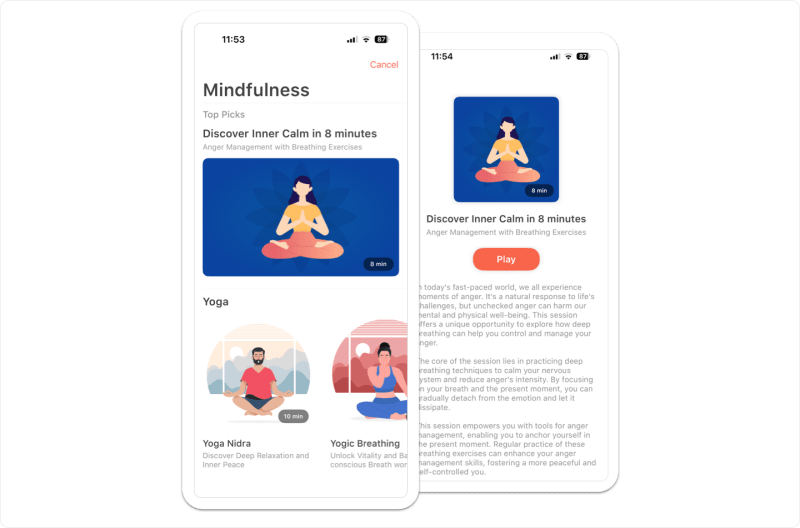
Recognizing burnout in a safety meeting is one thing; giving the team a way to act on it is another. Platforms like Vantage Fit pair a daily mood tracker with guided meditation sessions. This way employees who show signs of fatigue or overload in a toolbox talk have a next step beyond just talking about it.
Tracking burnout across the team? Download the free Workplace Mental Health Checklist to audit your policy, leadership training, and workload safeguards in one pass.
Conduct, training, and policy
Safety training requirements
Use the meeting to check who’s due for recertification and remind the team what training the role requires. This is also the moment to surface any new equipment or process that needs a walkthrough.
Workplace violence and harassment
Explain the organization’s zero-tolerance policy. Also, explain how to report disruptive or threatening behavior from coworkers, clients, or visitors. Make sure employees understand the policy applies to every department, not just customer-facing roles.
Yasmine Mustafa, CEO of workplace-safety technology company ROAR, has seen what happens when organizations skip the post-incident debrief:
"We've seen some organizations that will have what they call safety moments. Anytime something has happened, they take the time right after it's happened, when it's fresh, to sit down and talk to the employees about it. They open up that forum to have that conversation, and employees feel like the employer cares about them."
— Yasmine Mustafa, CEO & Co-Founder, ROAR | Listen to the full episode
Substance use on the job
Cover what the drug and alcohol policy actually says, when testing applies, and how prescription medication should be disclosed. Always remember: Vague policies get ignored and specific ones get followed.
Lockout/tagout procedures
Before maintenance or cleaning of any machine, it needs to be locked and tagged so no one else attempts to operate it. Walk through who’s authorized to apply and remove a lockout tag on your organization’s equipment.
Meeting starter: “If a machine on this floor needed to be locked out today, do you know the tag procedure?”
Communication and digital safety
Communication gaps

Missed handoffs between shifts or departments cause a disproportionate share of incidents. Use the meeting to confirm how safety-relevant information gets passed at shift change.
Phishing and social engineering awareness
Did you know? An estimated 3.4 billion phishing and fake emails are sent every day, per Valimail’s Email Fraud Landscape report. Explain what a suspicious email or message looks like and who to forward it to. It is an essential tip since phishing is as much a workplace-safety issue as a physical one.
Meeting starter: “Would you recognize a phishing attempt if it looked like it came from your manager?”
How do you run an effective safety meeting?
Keep the meeting short, specific, and conversational. Try to integrate simple day-to-day examples while explaining the safety topics. Aim for the following:
- Open with a question, not a lecture. Ask what safety issue came up this week before presenting one.
- Skip reading from a manual. A topic explained in your own words, tied to something that actually happened on site, lands better than a script.
- Prepare the specific topic in advance. A five-minute talk still needs thirty seconds of prep so it’s not generic.
- Stay on topic. One hazard per meeting is easier to retain than three unrelated ones.
Conclusion

A weekly safety topic, tied to a real hazard on your site and covered in five minutes, does more for a safety culture than one long annual training.
Safety is a shared responsibility between employer and employee, and it’s one half of what builds a positive work environment. A rotating topic list is one of the cheapest ways to keep it visible. Pick one topic from the list above, use the meeting starter to open the conversation, and rotate through the rest over the coming weeks.
Frequently asked questions
What is an example of a safety message?
A safety message names one specific hazard and one action, for example: "Wet floor near the loading dock, walk it, don't rush it." Effective ones are short, tied to a real condition, and copy-paste ready for a shift-start briefing.
What are some short safety reminders?
Short reminders work best when they name a specific hazard type: check your PPE before you start, report near-misses the same day, keep exit routes clear, and take scheduled breaks in high heat. Generic reminders like "stay safe" don't give anyone something to act on.
What's a good safety topic for a daily meeting?
The best daily topic is whatever hazard is most relevant to that day's work, a new piece of equipment, a weather condition, or a near-miss from the previous shift. When nothing site-specific stands out, rotate through a fixed list like the one above.
How long should a workplace safety meeting be?
Most toolbox talks run 5 to 10 minutes. Longer, in-depth training belongs in a separate scheduled session, not folded into a daily or weekly stand-up, where it will get rushed or skipped.