Workplace health promotion strategies are the structured actions an employer takes to protect and improve employee health. Five core approaches cover health risk assessments, activity during the workday, healthy eating, wellness apps such as Vantage Fit, and a healthy worksite. The World Health Organization attributes almost two million deaths a year to work-related causes.
Health promotion is a diverse subject that deals with approaches to promoting health among individuals. It enables people to increase control of health issues and improves quality of life.
At the workplace, it emphasizes the collaborative effort of bridging safety and wellbeing among employees and employers. It creates a healthy work environment that nurtures both personal and professional growth.
According to joint estimates from the World Health Organization and the International Labour Organization,
- Work-related diseases and injuries killed 1.9 million people in 2016.
- Noncommunicable diseases caused 81% of those deaths. Occupational injuries accounted for the other 19%, around 360,000 deaths.
- The largest single causes were chronic obstructive pulmonary disease (450,000 deaths), stroke (400,000), and ischaemic heart disease (350,000).
- Exposure to long working hours was linked to roughly 750,000 deaths.
Key Takeaways
- Workplace health promotion is the joint effort of employers and employees to protect safety and support wellbeing, covering policy, environment, and education.
- WHO and ILO attribute 1.9 million deaths in 2016 to work-related causes, with noncommunicable diseases accounting for 81% and occupational injuries for 19%.
- The five strategies here are health risk assessments, activity during the workday, healthy eating, wellness apps, and a healthy worksite.
- The WHO Ottawa Charter frames health promotion around healthy public policy, supportive environments, community collaboration, skills development, and reoriented health services.
- In Tata Motors' six-month Step and Stride Challenge on Vantage Fit, 1,248 active participants logged over 7,000 activities and reached 59% engagement.
What are some famous Health Promotion Strategies?
Various researchers prove that health promotion strategies are useful in developing and nurturing a healthy lifestyle. This also contributes to economic, social, and environmental wellbeing that defines health.
Managers across the world are inspired by the benefits of how these strategies boost employee wellbeing. Though making well-defined strategies varies according to an organization, a standard WHO Ottawa Charter for health promotion defines its strategy:
-
Devising a healthy public policy
-
Nurturing a supportive environment
-
Enforcing community collaboration
-
Fostering skill and development
-
Reorienting health services
5 Health Promotion Strategies For Your Organization
1. Regulate Health Risk Assessments
Health Assessments involve the process of questioning employees about their health and wellness conditions. Employees offered various tests and assessed based on their severity.
Those with modifiable health conditions are regularly administered with feedbacks, reports, and check-ups to boost wellness daily.
Ways to do it:
-
Biometric screening: It is the initial process biometric tests prove very helpful. It involves tests of blood pressure, cholesterol, height/weight, and blood glucose levels.
-
Corporate Health Checkup: For a more sophisticated process, it is advisable to invest in proper corporate health check-ups, they offer various advanced tests at discounts. It proves beneficial for severe employees who could not afford health costs.
2. Promote Activeness within Office
Some jobs demand employees more sitting hours, for example, IT professionals. These employees unknowingly live a sedentary lifestyle. It invites various health problems like obesity and diabetes. Some times this may lead to severe conditions of health problems. Your employees feel unproductive and feel afternoon slumps during work.
Ways to do it:
-
Walking Meetings: Taking walks while conducting a business meeting improves creativity and alertness among employees.
-
Advice to use Staircase: Employees are tempted to use elevators as a shortcut. But advising them to take the staircase will help in getting active for the day. It is a perfect cardio activity that also helps in building healthy joints.
3. Foster Healthy Eating Culture
Our consumption in a day effect substantially in our health. Healthy snacking is of utmost essential to keep our body fit.
Employees often choose unhealthy options, be it in meetings or office parties. This impacts their balanced diet and turns them obese in no time.
Ways to do it:
-
Celebrate Healthy Snack of Month: Advise your employees to switch their consumption into healthy lunches and healthy breakfast. You can also contribute to the idea of health and wellness by offering them healthy meeting snacks and office party snacks.
-
Offer meal and snack discounts: One way to motivate your employees for healthy consumption is by offering subscriptions of food joints that will provide healthy food. You can also review your catering menus of the office canteen with healthy options.
4. Administer Wellness Through Wellness Apps
If you have an organization with a large number of employees, managing each employee’s wellness may seem daunting.
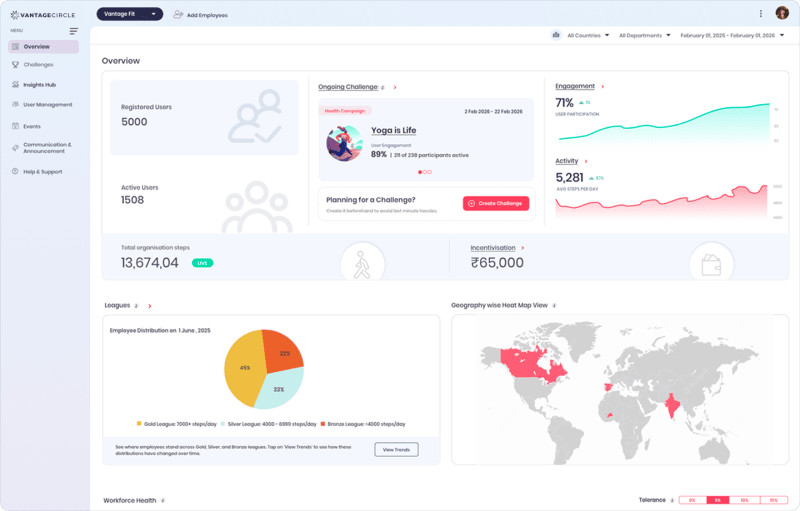
Taking the help of corporate wellness apps is one way to elevate the process of monitoring employee wellbeing. They offer various wellness solutions, starting from a real-time activity tracker to creating wellness campaigns.
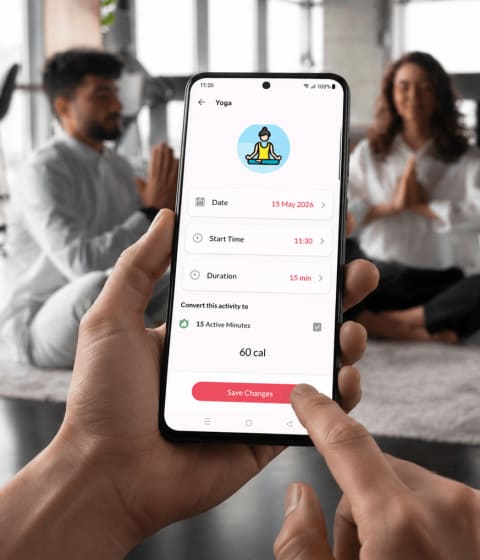
Platforms like Vantage Fit let HR teams build wellness campaigns, track employee activity across 30+ activity types, and view real-time participation data, all from a single admin dashboard. The platform syncs with Apple Watch, Fitbit, and Garmin, so employees are not required to manually log steps or workouts.
The impact is measurable. In Tata Motors’ Step & Stride Challenge — a 6-month multi-activity program run on Vantage Fit — the company achieved 59% employee engagement across 1,248 active participants, with employees logging over 7,000 activities including steps, meals, yoga sessions, and sleep.
Ways to do it:
-
Organize Wellness Campaigns: Wellness campaigns help promote a short-term health goal that contributes to creating a long-term health benefit. It helps in mitigating the modifiable health risks at an early stage.
-
Incentivize wellness activities: Rewarding and recognitions will boost employee engagement. They will be more willing to participate in wellness activities. This also creates healthy competition among employees for better health scores.
Also read: 7 Wellness Incentive Ideas To Boost Your Corporate Programs.
5. Offer Healthy Worksite
A healthy workplace nurtures positivity and creativity. Your employees feel more productive working in a healthy environment.
Creating a worksite wellness room helps your time constraint employees to workout while at the office. It helps them remain active for the day.
Ways to do it:
-
Make Onsite Yoga Room or Zen Worksite: Creating worksite Zen space or Yoga center relaxes employees from getting work burnouts. It helps in boosting mental health.
-
Offer Health Coaching: Corporate health coaching companies give an edge to the health promotional activities. They become the moderators between you and your employees to foster wellness among individuals.
Conclusion
Employees are the assets of an organization. They spent most of their lives in the office. Taking care of employees is vital for organizational growth. Healthy employees are productive at work and contribute to saving health costs.
Devising a proper promotional strategy for health education is imperative for an active workforce. Managers must address their employee’s issues while strategizing these activities for extensive participation in corporate wellness programs. Consider pairing these strategies with a structured wellness program evaluation to track what’s working.
Frequently Asked Questions
What is health promotion in the workplace?
Workplace health promotion is the joint effort of employers and employees to build a work environment that protects safety and supports wellbeing. It covers physical health, mental health, and the policies and spaces that shape both.
What are the 5 main workplace health promotion strategies?
The five covered here are health risk assessments, promoting activity during the workday, fostering healthy eating, administering wellness through apps, and offering a healthy worksite. Most programs combine several rather than relying on one.
What are the benefits of workplace health promotion?
Healthier employees take fewer sick days and are more productive, which lowers health costs. The World Health Organization attributes almost two million deaths a year to work-related causes, so prevention carries measurable value.
How do you measure a workplace health promotion program?
Track participation first, then health-risk changes from screenings and biometric data. In Tata Motors' Step & Stride Challenge, run on Vantage Fit, 1,248 active participants produced a 59% engagement rate over six months.
What is the difference between health promotion and a wellness program?
Health promotion is the broader discipline, covering policy, environment, and education. A wellness program is one way to deliver it, usually a structured set of activities, challenges, and incentives run over a fixed period.